Author: WAHH Coach Ume

  • Desk Job Aches: Acupressure helps

    Simple Acupressure Self-Massage for Office Worker

    It’s 2:30pm and you’ve just realised you’ve been sitting in the exact same position since 9am, hunched over your keyboard like a question mark that gave up on life. Your neck clicks when you turn it. Your shoulders feel like they’ve been up near your ears since the Monday standup. And somewhere between your third coffee and your inbox hitting triple digits, your lower back quietly filed a complaint that nobody read.

    Sound familiar? Welcome to the daily reality of working in Perth’s CBD, West Perth, or anywhere with a desk, a chair, and a deadline. Whether you’re in an office tower or working from your kitchen table in your trackies, the aches are the same.

    The good news is you don’t need a fancy ergonomic chair or a full remedial massage to feel some relief. A few simple acupressure points can be applied right at your desk, using nothing more than your own hands and a couple of spare minutes between meetings.

    Here are five points I recommend to clients who spend their day glued to a screen.
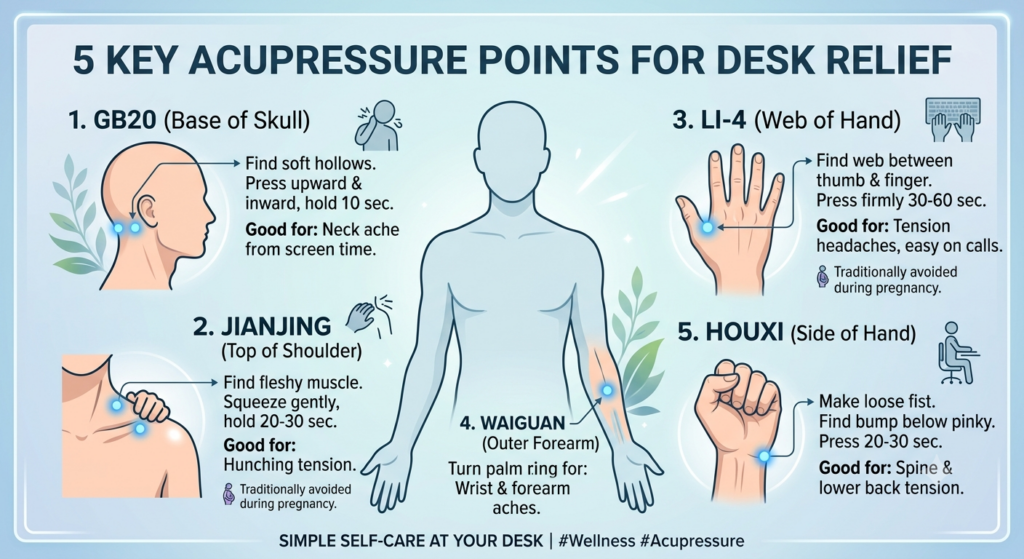
    Each one is easy to reach yourself, so there’s no need to recruit a coworker or explain why you’re doing something that looks suspiciously like yoga at your desk.

    1. GB20, at the Base of Your Skull

    Find the two soft hollows where your skull meets your neck, a couple of centimetres either side of your spine. Use your thumbs and press upward and inward, holding for a slow count of ten, a few times.

    This point is wonderful for the neck ache that builds up from staring at a monitor while nodding along in yet another video call. Tilt your head back slightly as you press for extra relief.

    2. G21 (Jianjing), on Top of the Shoulder

    Reach across your body and find the fleshy muscle on top of your opposite shoulder, roughly halfway between your neck and the edge of your shoulder. Use your fingers or thumb and squeeze gently, holding for 20 to 30 seconds before switching sides.

    This is the exact spot that tightens up when you spend the day hunched over a laptop, silently carrying the weight of your entire inbox. A little pressure here can feel remarkably good.

    Note: this point is traditionally avoided during pregnancy.

    3. LI4, in the Web of Your Hand

    Find the fleshy web between your thumb and index finger. Press firmly with the thumb of your other hand and hold for 30 seconds to a minute, then switch sides.

    Perfect for tension headaches that creep in after a long stretch of typing, and easy enough to do while you’re on a call and nobody can even tell.

    Note: this point is also traditionally avoided during pregnancy.

    4. TH5 (Waiguan), on Your Forearm

    Turn your palm downward and measure about three finger widths up from the crease of your wrist, on the outer side of your forearm, between the two bones. Press firmly with your thumb for 30 seconds, then switch arms.

    This point is great for the ache that builds up in your wrists and forearms from typing all day. Give it a go the next time your hands start to feel stiff from scrolling or clicking.

    5. SI3 (Houxi), on the Side of Your Hand

    Make a loose fist and look at the outer edge of your hand, below your pinky finger. You’ll find a small bony bump right where your palm meets your wrist. Press into it with the thumb of your other hand for 20 to 30 seconds, then switch sides.

    This point is often used for easing tension along the spine and lower back, which makes it a handy one for anyone who’s been sitting far longer than they meant to (which, let’s be honest, is most of us most days).

    A Quick, Honest Note

    These points are lovely for everyday tension and general relaxation, and many people find real comfort in using them throughout the day. They are not a substitute for proper medical care, and if you’re dealing with ongoing pain, numbness, or anything that feels off, please see your GP or physio to rule anything else out.

    Try It Before You Even Leave Your Chair

    Next time you notice your shoulders creeping up towards your ears, try one of these points before reaching for another coffee or standing up to complain to the person at the next desk. It takes less time than waiting for your computer to update.

    Want a proper reset? At WA Holistic Healing, we offer in person and online acupressure sessions right here in Perth, where we will show you exactly how to use these points, plus a few more, for lasting relief from desk related aches.

  • Mindfulness for Stress Relief: A Simple Practice That Changed How I Handle Pressure

    Stress used to feel like a constant companion in my life. Between work responsibilities, personal commitments, and everyday challenges, it often felt like there was always something demanding my attention. My mind was constantly busy, and even when I had time to relax, I struggled to switch off.


    That’s when I began exploring mindfulness as a tool for stress relief.

    Initially, I was skeptical. Stress seemed like a complicated problem, and mindfulness sounded almost too simple. However, after incorporating mindfulness into my routine, I discovered that it provided a practical way to manage stress without needing to completely change my circumstances.


    One of the first things mindfulness taught me was that stress often comes from our relationship with our thoughts rather than the situation itself. When something stressful happened, my mind would immediately jump to worst-case scenarios, future worries, and endless what-if questions. Mindfulness helped me recognize these thought patterns before they spiraled out of control.


    The foundation of my mindfulness practice was breathing. Whenever I felt overwhelmed, I would pause and focus on my breath for a few moments. I noticed the sensation of air entering and leaving my body and allowed my attention to settle on that simple experience. While it didn’t make my problems disappear, it helped create a sense of calm and clarity.


    Another powerful mindfulness technique for stress relief was grounding myself in the present moment. Stress often pulls us into worries about the future or regrets about the past. By focusing on what was happening right now, I could reduce the mental load I was carrying.
    For example, during stressful days, I would take a short walk and pay attention to my surroundings. I would notice the colors of the trees, the sound of birds, or the feeling of sunlight on my skin. These moments reminded me that not every second needed to be consumed by stress.


    Mindful body scans also became a valuable tool. I learned that stress frequently showed up in my body before I consciously recognized it. Tight shoulders, headaches, and muscle tension were often signs that I needed to slow down. Taking a few minutes to scan my body and release tension helped prevent stress from building further.


    One unexpected benefit of mindfulness was improved emotional awareness. Instead of immediately reacting to stressful situations, I became better at observing my emotions. This created a small but important gap between feeling stressed and acting on that stress. Within that gap, I could choose a more thoughtful response.


    I also discovered that mindfulness works best when practiced consistently rather than only during difficult moments. By incorporating mindfulness into my daily routine, I built a foundation of resilience that made it easier to handle challenges when they arose.

    Simple practices like mindful eating, mindful walking, or a few minutes of meditation each morning helped strengthen this habit. Over time, mindfulness became less of an exercise and more of a way of living.


    Perhaps the most important lesson mindfulness taught me was acceptance. Stress often becomes worse when we fight against reality or wish circumstances were different. Mindfulness encouraged me to acknowledge what was happening without judgment. From that place of acceptance, I found it easier to make decisions and move forward productively.


    Today, I still experience stress because stress is a normal part of life. The difference is that stress no longer feels like something that controls me. Mindfulness has given me practical tools to remain calm, focused, and present even during challenging situations.


    If you’re looking for a natural way to manage stress, mindfulness is worth exploring. You don’t need tobe an expert, and you don’t need hours of free time. Start with a few mindful breaths, a short walk, or amoment of awareness during your day.


    Small practices, repeated consistently, can have a remarkable impact on how we experience stress. They certainly did for me.

    Contact us at WA Holistic Healing to explore more and allow us to help. Explore our services.